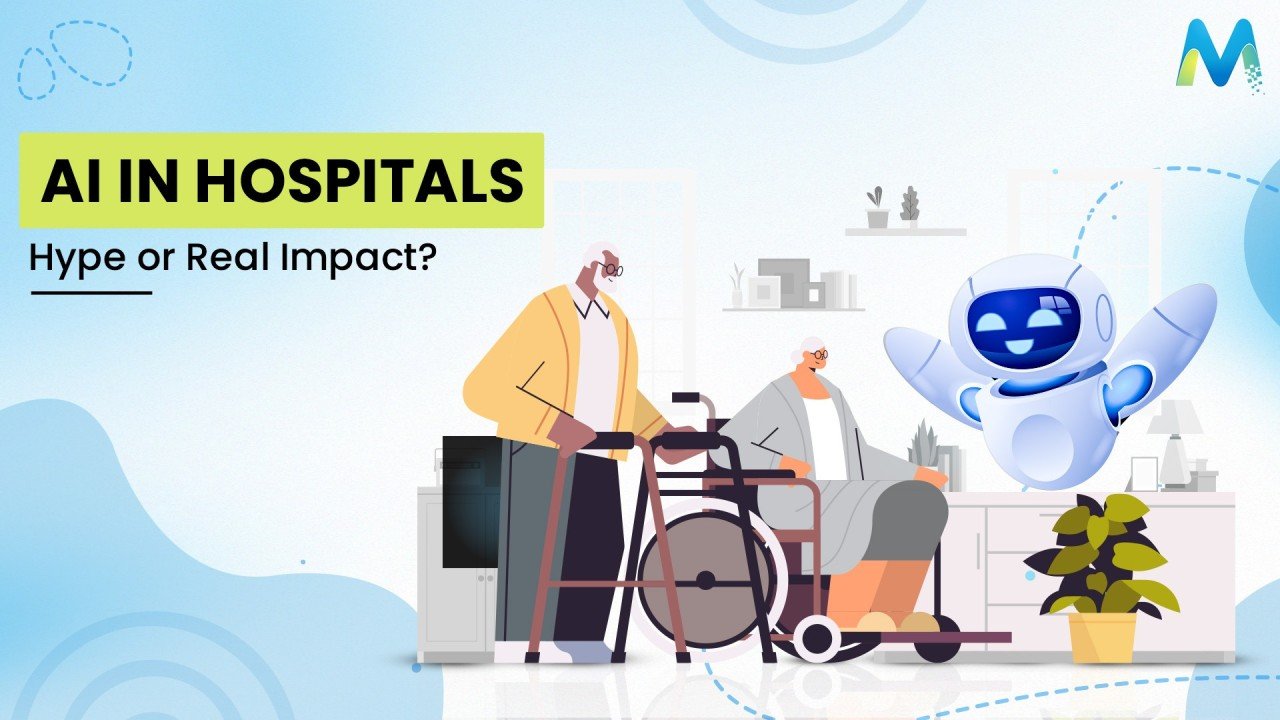
Many of you have heard promises that Artificial Intelligence (AI) will diagnose cancer before doctors can. It has the power to reduce that traditional paperwork overnight and can give far better solutions than humans. This revolutionizes the healthcare industry, meaning AI is no longer a distant concept. It's in radiology suites, billing departments, ICUs, and emergency triage systems.
The question is no longer whether AI has arrived in healthcare. The real question is: how much of it is actually working? What are its benefits for hospitals? Let us find out ahead of time in this blog whether AI is actually ruling the market or not.
How is AI Becoming A Strategic Tool for the Healthcare Industry?
Where AI Is Creating Real Impact?
Artificial Intelligence has become a strategic tool to transform the key operations within the healthcare system. Be it billing systems or simplifying the records, it has become the key asset. Some of the modern uses are explained further:
1. The most convincing evidence for AI's value in healthcare comes from medical imaging. Algorithms trained on millions of X-rays, MRIs, and CT scans can now detect conditions like lung cancer, breast cancer, or diabetic retinopathy with accuracy.
2. In busy hospital settings where radiologists are stretched thin, AI tools are catching what most of the clinicians might miss and reducing diagnostic backlogs that once delayed life-saving treatment.
3. Beyond imaging, AI is making measurable inroads in clinical workflows. Medical transcription tools automate documentation in real time, reducing after-hours work and supporting the overall system's treatment guidance.
Modern Case Studies to Note Down
Well, there are no theoretical gains; they are being felt in hospitals where doctors are spending less time buried in electronic health records and more time with patients.
1. AI algorithms are being used to analyze ECGs to detect early signs of heart failure and atrial fibrillation, often before symptoms appear, enabling earlier interventions and reducing hospitalizations. In parts of India, low-cost AI programs are screening patients in rural areas for diabetic retinopathy, allowing early detection even in regions with few ophthalmologists.
2. In hospital operations and billing, the gains are equally tangible. AI-powered revenue cycle tools are helping hospitals reduce claim denials, automate insurance eligibility verification, and flag coding errors before they become rejected payments.
3. Some health systems have reduced their coding-related denial rates to under 0.1% using autonomous AI coding engines, which is a figure that would have seemed impossible under any manual system.
Where the Hype Is Bigger Than Reality
AI in healthcare also carries a significant weight of overblown expectations. Despite the enthusiasm, AI's real-world impact remains controversial. The gap between what AI can do in a controlled research environment and what it actually delivers in a real hospital remains wide.
The "Black Box" Problem
Many AI systems produce results related to diagnosis, a risk score, or a recommendation, without explaining how they arrived at it. Clinicians and regulators alike are uncomfortable deploying tools they cannot interrogate, and rightly so. In a field where accountability can mean the difference between life and death, opacity is not a minor inconvenience.
Bias and Equity
Skewed datasets risk worsening existing health disparities, particularly for patients from underrepresented populations whose conditions may be poorly reflected in the training data. An AI system that works brilliantly for one demographic and fails another is not a healthcare solution; it is a healthcare risk.
Integration Challenges
Most hospitals are running on legacy IT infrastructure that was never designed to communicate with modern AI systems. Getting a cutting-edge algorithm to work within a decades-old electronic health record is a far messier problem than most vendor pitches acknowledge.
Data Privacy and Transparency
Challenges such as data privacy and transparency concerns with large language models in clinical research and data analysis can complicate deployment. Until these issues are addressed, widespread AI adoption in hospitals will continue to face significant challenges.
What Makes AI Successful in Hospitals?
The hospitals where AI is delivering the clearest results share a few things in common. Here is what separates the implementations that work from those that don't.
Deploying AI Where It Actually Fits
The most successful hospitals are deploying AI in areas where the technology's core strength, such as pattern recognition across enormous datasets, maps directly to a well-defined clinical problem. Radiology, pathology, and risk scoring are natural fits. Trying to apply AI to complex, emotionally nuanced clinical conversations is a much harder task. The lesson is simple: match the tool to the task.
Treating AI as a Partner, Not a Decision-Maker
Successful implementations treat AI as a support tool rather than a decision-maker. Experts increasingly frame AI as "augmented intelligence", which is a partner to doctors, not a substitute. The hospitals seeing the best outcomes are those where AI handles the volume and humans handle the nuance.
The Verdict: Real Impact, with Eyes Open
So, whether AI is hype or real impact? The answer is: both, depending on where you look. AI is making a difference, but in pockets rather than everywhere. Imaging, transcription, and drug discovery show measurable gains, while patients’ engagement and system-wide integration remain uneven.
The technology is neither the magic cure its most enthusiastic advocates promise, nor the overhyped disappointment. It is a powerful set of tools that works well when it is utilized thoughtfully in the right context, and underdelivers when treated as a shortcut or a solution in search of a problem.
Healthcare organizations that approach AI with clear goals, honest assessment, and a commitment to continuous improvement are the ones turning promise into practice. For them, the impact is real indeed.
Recommended